
Physical Changes in Elderly

(1) Cells: fewer but larger size, reduced intra and extra cellular fluid.
(2) Nervous System: rapid decrease neural connections, slow in response time to react, diminishing the nervous system senses of hearing, presbiacusis, tympanic membrane atrophy, due to the increased occurrence of serum collection ceratin.
(3) Vision System: sclerosis arising pupillary sphincter and loss of response to the synapse, the cornea is more shaped speris, cloudy lens, increasing the threshold of observation of light, loss of accommodation, decreased visual field.
(4) Cardiovascular System. : Heart valves thicken and become stiff, the heart's ability to pump blood decreases 1% every year after age 20 years, causing contraction and decline in volume, loss of elasticity of blood vessels, blood pressure rises.
(5) Respiration System : respiratory muscles become stiff so that causes decreased activity of cilia. Lungs lose their elasticity so that the residual capacity increases, breath heavy. Depth of breathing decreased.
(6) Gastrointestinal System: loss of teeth, causing malnutrition, decreased sense of taste because of the mucous membrane and atrophy of the senses of taste up to 80%, then the loss of nerve sensitivity of taste for sweet and salty taste.
(7) Genitourinary System: kidney nephron shrink and become atrophic so that blood flow to the kidneys decreased to 50%, GFR decreased to 50%. Renal threshold for glucose is enhanced. Urinary vesicles, the muscles become weaker, its capacity is decreased to 200 cc so difficult urinary-derived vesicles in elderly men would result in retensia urine. Enlarged prostate, 75% experienced by men over 55 years. In the vulva occurs vaginal atrophy are going dry mucous membranes, decreased tissue elasticity, and reduced secretion becomes alkaline.
(8) Endocrine System: endocrine system on almost all hormone production decreases, whereas the parathyroid function and secretion did not change, decreased thyroid activity resulting in lower basal metabolic rate (BMR). Porduksi decreased sex cells such as progesterone, estrogen and testosterone.
(9) Integumentary System: skin becomes wrinkled due to loss of fat tissue, scalp and thinning hair becomes gray, whereas in the ear and nose hair thickened. Become hard and brittle nails.
(10) Musculoskeletal System: bones lose density and become more fragile kiposis, height is reduced vertebral discusine called thinning, the tendon fibers shrink and atrophy - muscle fibers, so that the elderly be slow moving. muscle cramps and tremors.
Mental Changes in Elderly
Factors that affect the mental changes are:
Psychosocial Changes
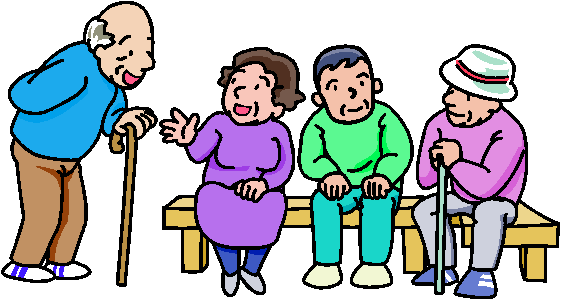
Retirement: a value measured by productivity, identits associated with a role in job
Sensing or aware of the death
The change in the way of life, ie moving into a nursing home is more narrow.
• Impaired self-concept due to loss of losing office.
• The series of losses, namely loss of relationships with friends and family.
• Loss of physical strength and sturdiness, changes to the self-image, self-concept changes.
Spiritual Change
Religion or belief increasingly integrated in the life (Maslow, 1970) Elderly more mature in their religious life, this is seen in thinking and acting in everyday (Murray and Zentner, 1970)
(1) Cells: fewer but larger size, reduced intra and extra cellular fluid.
(2) Nervous System: rapid decrease neural connections, slow in response time to react, diminishing the nervous system senses of hearing, presbiacusis, tympanic membrane atrophy, due to the increased occurrence of serum collection ceratin.
(3) Vision System: sclerosis arising pupillary sphincter and loss of response to the synapse, the cornea is more shaped speris, cloudy lens, increasing the threshold of observation of light, loss of accommodation, decreased visual field.
(4) Cardiovascular System. : Heart valves thicken and become stiff, the heart's ability to pump blood decreases 1% every year after age 20 years, causing contraction and decline in volume, loss of elasticity of blood vessels, blood pressure rises.
(5) Respiration System : respiratory muscles become stiff so that causes decreased activity of cilia. Lungs lose their elasticity so that the residual capacity increases, breath heavy. Depth of breathing decreased.
(6) Gastrointestinal System: loss of teeth, causing malnutrition, decreased sense of taste because of the mucous membrane and atrophy of the senses of taste up to 80%, then the loss of nerve sensitivity of taste for sweet and salty taste.
(7) Genitourinary System: kidney nephron shrink and become atrophic so that blood flow to the kidneys decreased to 50%, GFR decreased to 50%. Renal threshold for glucose is enhanced. Urinary vesicles, the muscles become weaker, its capacity is decreased to 200 cc so difficult urinary-derived vesicles in elderly men would result in retensia urine. Enlarged prostate, 75% experienced by men over 55 years. In the vulva occurs vaginal atrophy are going dry mucous membranes, decreased tissue elasticity, and reduced secretion becomes alkaline.
(8) Endocrine System: endocrine system on almost all hormone production decreases, whereas the parathyroid function and secretion did not change, decreased thyroid activity resulting in lower basal metabolic rate (BMR). Porduksi decreased sex cells such as progesterone, estrogen and testosterone.
(9) Integumentary System: skin becomes wrinkled due to loss of fat tissue, scalp and thinning hair becomes gray, whereas in the ear and nose hair thickened. Become hard and brittle nails.
(10) Musculoskeletal System: bones lose density and become more fragile kiposis, height is reduced vertebral discusine called thinning, the tendon fibers shrink and atrophy - muscle fibers, so that the elderly be slow moving. muscle cramps and tremors.
Mental Changes in Elderly
Factors that affect the mental changes are:
- First of all the physical changes, particularly the organs of taste
- Health
- The level of education
- Heredity
- Environment
Psychosocial Changes
Retirement: a value measured by productivity, identits associated with a role in job
Sensing or aware of the death
The change in the way of life, ie moving into a nursing home is more narrow.
• Impaired self-concept due to loss of losing office.
• The series of losses, namely loss of relationships with friends and family.
• Loss of physical strength and sturdiness, changes to the self-image, self-concept changes.
Spiritual Change
Religion or belief increasingly integrated in the life (Maslow, 1970) Elderly more mature in their religious life, this is seen in thinking and acting in everyday (Murray and Zentner, 1970)


